
Lean Project Management: Doing More with Less
In a world where projects are becoming increasingly complex, lean project management offers a refreshing approach. Born out of lean manufacturing principles, this method helps teams maximise value while minimising waste delivering faster outcomes, with fewer resources, and better alignment to customer needs.
What Is Lean Project Management?
Lean project management is a methodology that focuses on streamlining processes, reducing inefficiencies, and delivering only what is truly valuable to the end user.
Unlike traditional methods that often get bogged down in excessive documentation or rigid workflows, lean champions adaptability, feedback loops, and continuous improvement.
At its core, lean project management embraces five key principles:
- Define Value: Understand exactly what the customer considers valuable.
- Map the Value Stream: Identify every step in the process and remove waste.
- Create Flow: Ensure work progresses smoothly without delays or bottlenecks.
- Establish Pull: Let customer demand drive work, not internal schedules.
- Pursue Perfection: Continuously improve processes and results.
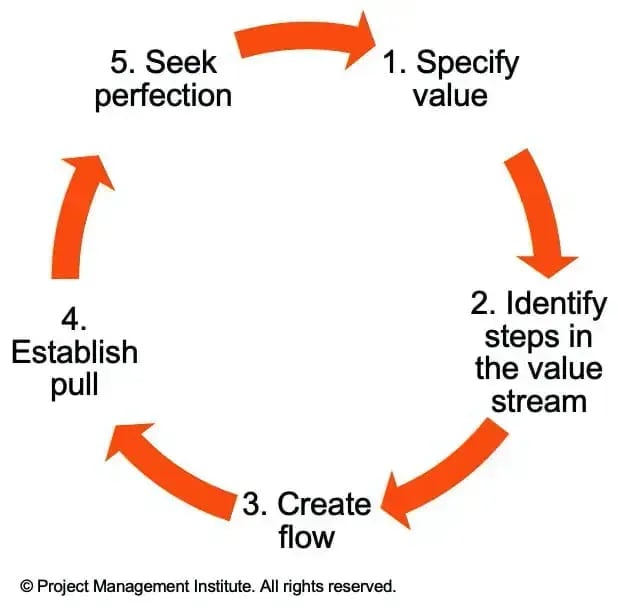
The five principles of lean. Source: PMI
Why Lean Matters Today
With tightened budgets, hybrid workforces, and rapidly shifting priorities, organisations are under pressure to do more with less. Lean project management meets this challenge by encouraging teams to focus only on what delivers outcomes. It also shortens feedback cycles, making it easier to adapt to change without derailing the entire project.
Teams that apply lean principles often report faster delivery times, higher stakeholder satisfaction, and a stronger alignment between business goals and project outputs.
Lean Project Management in Action
Take, for example, a project team rolling out a new IT system across multiple departments. Instead of designing a detailed plan up front and delivering everything at once, a lean approach would start by identifying the minimum viable solution for one department. They’d gather feedback, improve, then replicate what works across the organisation saving time, money, and effort.
This iterative delivery model is especially well supported by modern project portfolio tools that are built to adapt. Platforms that provide visual workflows, embedded automation, and real-time data visibility make it easier to apply lean thinking at scale.
Tools That Support Lean Thinking
While lean project management is a mindset first, the right tools can amplify its impact. Platforms that are built on flexible cloud environments, allow you to configure lightweight workflows, and can evolve with your organisation’s needs are especially valuable.
One such example is a solution we’ve seen successfully used in both government and enterprise environments built on Microsoft’s Power Platform. It gives project teams full visibility into their portfolio, while enabling agile delivery practices, resource optimisation, and outcome tracking all aligned with lean principles.
Final Thoughts
Lean project management isn’t about cutting corners. It’s about delivering value with intention. By eliminating waste and focusing on what matters most, organisations can unlock faster results, greater clarity, and better ROI.
Whether you’re managing digital transformation or capital works, adopting lean principles could be the shift your organisation needs to thrive in today’s unpredictable environment.

IIR: Introduce, Integrate, Replace
Step 01
Introduce
You cannot run a portfolio on Excel and PowerPoint alone.
Project portfolio management is the discipline of seeing every project in one place, prioritising the work that matters, allocating people against demand, and governing delivery with real numbers. It is not optional at any serious scale. The moment you have more projects than one person can hold in their head, you need a single, current view of status, schedule, cost, resource and risk.
Excel and PowerPoint feel free because there is no licence conversation. The real cost is elsewhere. It is the hours spent maintaining workbooks, the version confusion, and the numbers that go stale the moment they are pasted.
A spreadsheet cannot tell you, on demand, which projects are at risk, where your people are over-committed next quarter, or how much of the portfolio budget is actually spent.
Introducing a proper PPM platform is the first step. Not to add another tool for its own sake, but to give the portfolio one place where the data lives together and stays live.
Step 02
Integrate
The instinct after buying a PPM platform is to make everyone move into it. That is the fastest way to fail. Project managers already have tools they trust, and finance already has systems of record. Force a migration on day one and you get resistance, shadow spreadsheets, and a dataset nobody believes.
Integrate first. Meet the data where it already is. Two directions matter.
Direction 01
Enterprise systems
Connect to the finance or ERP layer so actuals, commitments and budgets flow in automatically. Reporting stops being a monthly reconciliation and becomes a live view. Nobody rekeys a spend figure again.
Direction 02
The tools PMs already use
The direction most platforms neglect, and arguably the more important. The portfolio should read from the PM's own tools, not force people to abandon them.
The reason this matters is simple. That data is already there, and it is kept current by the person closest to it. When the portfolio reads directly from these sources, the status report updates itself. No chasing, no copy and paste, no reporting lag. The PM keeps working the way they always have, and the board gets a live picture as a side effect.
Step 03
Replace
Integration buys you two things: trust, and live data. Once both are in place, you look at what can go.
Every organisation carries tools and spreadsheets that either do not do the job well or carry a heavy maintenance overhead. The classic example is the resource spreadsheet. It is a workbook someone maintains by hand to track who is on what. It is always slightly out of date, owned by one person, and impossible to reconcile against real demand.
Replace it with the equivalent function in your PPM.
A proper demand management capability does what the spreadsheet was reaching for, with none of the overhead. It models demand against capacity across the whole portfolio, updates as projects shift, and needs no manual upkeep.
Replace deliberately, one function at a time, and only after the platform has earned it. The test is simple: if a spreadsheet is high overhead or low quality, and the platform does the same job natively, retire the spreadsheet.
The payoff
You stop producing reports and start reading them
Follow IIR and the nature of reporting changes. The status view is current because it is fed by the tools people already use and the systems that already hold the money. The overhead that used to consume the last week of every month disappears, because there is nothing to assemble.
That is the whole point of real-time reporting. Not a prettier deck, but a portfolio you can look at any day of the month and trust, at a fraction of the effort it takes today.
Built on Microsoft 365. Native ground for IIR.
pmo365 integrates with the tools your teams already run in, so the path from Introduce to Integrate to Replace is a natural progression rather than a rip and replace.
