
Barriers to Successful IT Project Governance
What makes IT project governance different from normal project governance? And what are the barriers project managers face when running IT projects?
As the world relies more and more on technology, and especially with the rise of Artificial Intelligence, organisations are putting an increasing value IT projects. Demand is constantly growing, with Gartner projecting that global IT spending will reach a total of $4.5 trillion by 2022. This isn’t a new trend either. Some 89% of companies already prepared to grow their IT budgets from 2019.
However, there are some key differences that must be addressed when managing IT Projects. We look at some of the problems that managers may come across and how these might be overcome.
What makes IT Project Governance Different?
While the core functions of project governance are largely universal, the techniques may vary depending on the project’s context and its methodology. Historically, project governance has been understood as traditional Waterfall-based stage-gate methodologies, which has been considered unsuitable for IT project governance.
Many IT projects apply iterative methodologies like Agile that are inherently different from traditional methodologies. These differences have led Agile advocates to declare that project governance has no place in IT projects. This is mostly due to their emphasis on customer value, flexible requirements, iterative structures, and self-governing qualities. However, while Agile projects may indeed be different, that does not mean that project governance is invalid.
Whether you’re running Waterfall or Agile-based projects, every project team wants to make the right decisions to achieve their goals. Agile governance is not about adding more rules to projects, but about establishing the fastest route to create the most value.
What is IT Governance
Gartner defines IT governance (ITG) as ‘the processes that ensure the effective and efficient use of IT in enabling an organisation to achieve its goals.’
IT projects are often iterative, and demands for product upgrades, updates, and new products are always fighting for priority. IT demand governance (ITDG) determines how all these demands are prioritised and selected. Gartner’s extended definition includes further details about ITDG, including the ‘process by which organizations ensure the effective evaluation, selection, prioritization, and funding of competing IT investments; oversee their implementation, and extract (measurable) business benefits.’
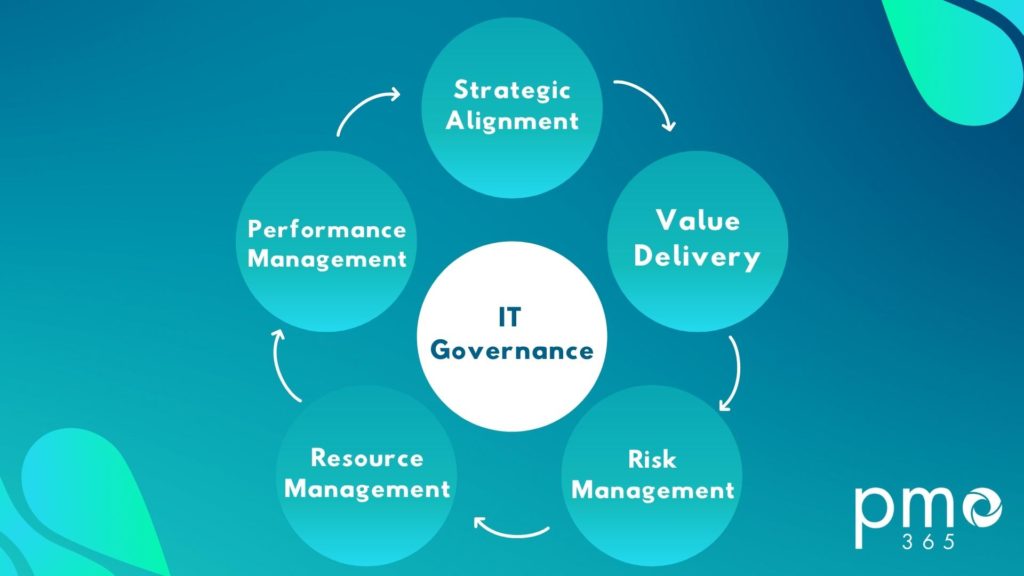
IT Project Governance Frameworks are often concerned with 5 key aspects:
- Strategic Alignment: Making sure that IT investments and projects are aligned with the business strategy
- Value Delivery: Ensuring that IT investments and projects deliver value over their entire life cycle
- Risk Management: Ensuring the strategic objectives of the organisation are not jeopardized by potential IT project failure
- Resource Management: Ensuring thes of IT resources
- Performance Measurement: Ensuring all stakeholders understand how IT investments and projects are contributing to the achievement of the organisation’s objectives.
Barriers to successful IT project Governance
1. Inadequate understanding of rules and regulations
This involves both internal and external regulations. Firstly, many organisations fail to set simple, clear and consistent rules or regulations regarding IT Governance that can be easily understood by the organisation.
Additionally, IT rules and regulations should adhere to IT compliance requirements that ensure the security of both desired by the customer and required by law. These compliance requirements may vary depending on the industry of the business and the type of IT project.
2. Inadequate governance frameworks
Perhaps resulting from a lack of understanding, IT governance frameworks often fail to adequately balance necessary compliance requirements with freedom to action and expression. This often leaves teams feeling leashed and less willing to push innovative out-of-the-box ideas.
Finding the balance and crafting the right framework for your organisation’s context is critical to project success. Research shows that organisations that invest in proven project management practices waste 28 times less money.
3. Lack of Communication of Value
It’s not uncommon for different priorities between the IT department and senior management to cause miscommunication. IT teams like to discuss projects in terms of customer value, while management teams often discuss projects in terms of functional value and business benefits. A unclear communication of value often leads to a lack of buy-in and ownership from key stakeholders, that can be detrimental to project success.
Read more: Project value vs Project Benefits
4. Lack of Commitment from Senior Management
As a result from miscommunication between senior management and the IT department, IT projects often lack a sponsor. A sponsor who is accountable for project goals and benefits, and who can mediate conflicting demands is essential to keeping projects on track. When dates start slipping, tasks run over schedule and roadblocks start emerging, strong ownership can play an important role in ensuring project success.
Governance in any organisation with any methodology needs to be an enterprise-wide initiative to be truly successful. Simply putting the weight of governance on a single team or department is bound to lead to governance implementation failure.
5. Lack of Financial Support
Lack of communication and commitment from senior management often leads to lack to lack of financial support. However, other factors often come into play with IT projects. IT projects typically start with unclear objectives which often makes them prone to project scope creep and budget overruns. These ambiguities can have a significant impact on project success with research showing that project professionals believe that poor estimation during project planning phases is the biggest contributor to IT project failures.
6. Lack of Business and IT integration
IT projects are not just undertaken by software and tech companies. Every day, for example, retail companies and even NGOs are engaging in IT projects, as consumers become increasingly integrated and dependent on digital technologies and services. For too long, IT development has been relegated to the IT team, which results in poor integration with the overall organisation and its strategy.
For IT projects to be successful, IT governance needs to consider the varying needs and requirements of both the business and IT to create a framework that incorporates and addresses both perspectives.
7. IT staff are less oriented towards business
Sometimes IT teams can speak their own language, and have unique perspectives that can be detached from the greater organisation. For IT governance to be accepted by both IT teams and the wider organisation, IT teams need to adapt to have the necessary skills and attitudes to support business function and act as business enablers.
Take your IT project governance to the next level with pmo365
The team at pmo365 know just how important good IT project governance is for project success. But achieving it may not be so simple, especially if you don’t have the right PPM solution working for you. Check out how our pmo365‘s integrated PPM solution will automate, analyse, optimise and visualise your project governance activities so all your teams can work on the same page for project success.